
Understanding Anabolic Resistance and How Deep Sleep Can Improve It
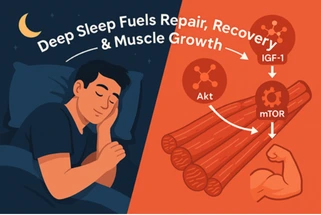
Anabolic resistance is the reduced ability of muscle to repair, rebuild, and grow even when training and nutrition are on point. While often associated with aging, anabolic resistance also appears in younger adults when deep sleep is low or fragmented, inflammation is elevated, or recovery pathways are disrupted. Muscle protein synthesis (MPS) is the cellular process that builds new muscle proteins and repairs damaged fibers after training. Because deep sleep drives growth hormone (GH) and insulin-like growth factor (IGF-1) and the downstream Akt (Protein Kinase B) → mTOR (mechanistic Target of Rapamycin) pathway, poor-quality sleep can weaken MPS at any age. Understanding how this works and how to restore it is essential for maintaining strength, performance and long-term physical resilience.
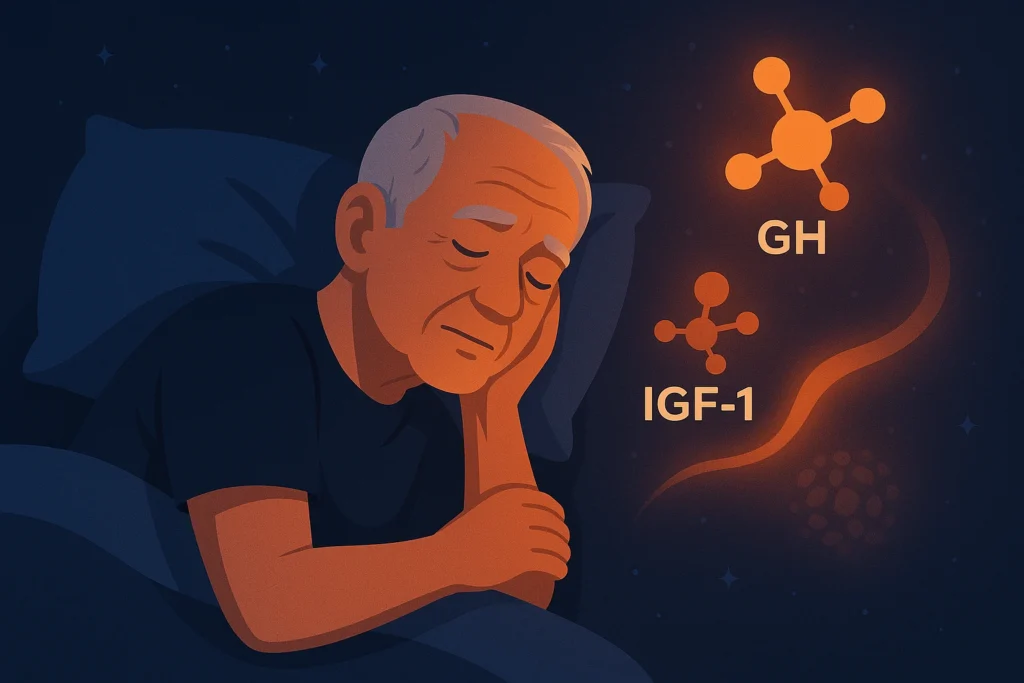
Pay attention if your sleep tracker shows consistently low deep sleep. Deep (slow-wave) sleep is the phase where your body releases the highest levels of growth hormone and IGF-1, the key signals that tell your muscles, joints, and tissues to repair, rebuild, and get stronger. Without enough deep sleep, the pathway that drives MPS and recovery never fully switches on… no matter how hard you train or how well you eat.
People with chronically low deep sleep often notice slower muscle repair and nagging soreness, higher fatigue and inflammation and a harder time staying lean, toned, and energized. Improving deep sleep isn’t just about feeling rested, it’s about unlocking recovery, repair, and results.
Deep Sleep and Muscle Repair Pathway
Deep Sleep → Growth Hormone → IGF-1 → Akt → mTOR forms one of the body’s primary muscle-building pathways. This is the hormonal muscle repair pathway most strongly supported by deep sleep, making it essential for nighttime repair, recovery, and MPS.
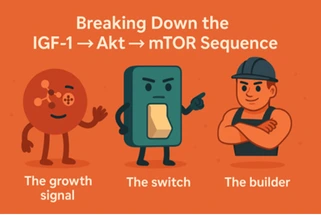
“The growth signal → the switch → the builder.”
IGF-1 = the growth signal
Akt = the central switch that turns growth processes ON
mTOR = the construction manager that directs ribosomes to build new muscle proteins
MPS How it Works:
Step 1 – IGF-1 rings the doorbell. IGF-1 binds to its receptor on the muscle cell surface and initiates the PI3K–Akt signaling pathway.
Step 2 -Akt flips the switch. Activated Akt. This turns ON mTORC1 and Turns OFF molecular “brakes” like TSC2 that normally suppress growth.
Step 3 – mTOR builds the muscle mTORC1. This activates p70S6K, boosting protein translation, and Phosphorylates 4E-BP1, freeing eIF4E so mRNA translation can begin.
Result – MPS increases this allows muscle fibers to repair, rebuild, and adapt to training.
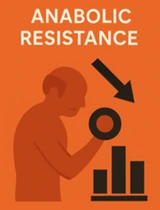
Aging effects on MPS Pathway
In aging skeletal muscle (ASM), several problems reduce pathway strength:
Lower or dysregulated IGF-1
Blunted Akt activation after exercise or feeding
Reduced mTORC1 signaling
More “brakes”: inflammation, oxidative stress, myostatin
Slower ribosome production, which limits the machinery needed for MPS
How Poor Deep Sleep Disrupts the Pathway
Aging isn’t the only reason this pathway weakens. Poor-quality deep sleep disrupts the same molecular steps just as strongly.
- Low Deep Sleep → Low GH → Low IGF-1
Poor deep sleep means lower GH, lower IGF-1 and reduced activation of Akt and mTOR. The repair cycle never fully starts.
- Fragmented Sleep Increases Inflammation
Light, disrupted, or restless sleep increases cortisol levels, sympathetic activation, and inflammatory cytokines.
Inflammation directly suppresses mTOR, reducing MPS.
- Less Parasympathetic Recovery → More AMPK (the anti-growth signal)
Poor deep sleep keeps the body in sympathetic mode which raises AMPK (mTOR off-switch), increases metabolic stress and impairs cellular repair.
- Poor Deep Sleep Reduces Training Quality
Low deep sleep makes – strength output lower, muscle recruitment worse, rate of perceived exertion (RPE) higher and recovery slower.
💡 You don’t have to be old to experience anabolic resistance. Low-quality deep sleep creates the same bottlenecks at any age.
Where Deep Sleep Fits In
Deep sleep supports GH surges, IGF-1 production, reduced inflammation, parasympathetic recovery and nighttime tissue repair. Improving deep sleep improves the internal environment required for MPS, even though it can’t fully reverse the age-related decline in how the muscle cell responds.
- Aging reduces Akt/mTOR efficiency.
- Deep sleep strengthens the IGF-1 signal that drives it.
Summary
IGF-1 activates the Akt/mTOR pathway, which tells muscles to build new proteins after training. In older adults, this signaling becomes less efficient, making it harder to build or maintain muscle.
Deep sleep is the body’s most powerful natural way to support this pathway. During slow-wave sleep, GH and IGF-1 rise, inflammation falls, and the body enters its most anabolic state. From young athletes, to seniors, to master competitors, deep sleep is the key that allows training to become real, lasting progress.
💥 You can’t out-train bad sleep.
🎯 With deep sleep restoration the body finally has what it needs to repair, rebuild, and grow.
Paul Mawson
Key Scientific References:
1 Barclay et al., 2019. The Role of the IGF-1 Signaling Cascade in Muscle Protein Synthesis (MPS) and Anabolic Resistance in Aging Skeletal Muscle.
Journal of Muscle Research and Cell Motility
2 Yoshida et al., 2020. Mechanisms of IGF-1–Mediated Regulation of Skeletal Muscle Protein Synthesis. Frontiers in Physiology